Our hands-on methodology · Erasmus+ & European Solidarity Corps
Microgreens as an educational tool.
A tray of seeds is one of the most versatile teaching tools we have. In a week or two those microgreens become a hands-on lesson in green skills, digital skills and entrepreneurship — cheap enough for everyone and fast enough to finish inside any mobility. The method was authored by our president, piloted by our sister organisation in Athens, and is now being brought to Kocani. This is how it works, and how to be part of it here.
One tray. Every programme.
These are European methods — this one grows in a tray; the others use a solar panel, mycelium and drones. They need nothing a town like Kocani doesn’t already have.
You don’t need to know anything about growing. No garden, no green fingers, no prior attempt that died. The method is built so a facilitator can run it cold, and so a participant who has never kept a plant alive gets a harvest in their first ten days.
Fast, cheap, inclusive — and it fits everywhere.
The reason the same activity works for a school class, a senior group, a vocational mobility or an international youth exchange comes down to a few simple numbers.
The method
From a tray of seeds to a transferable skill set.
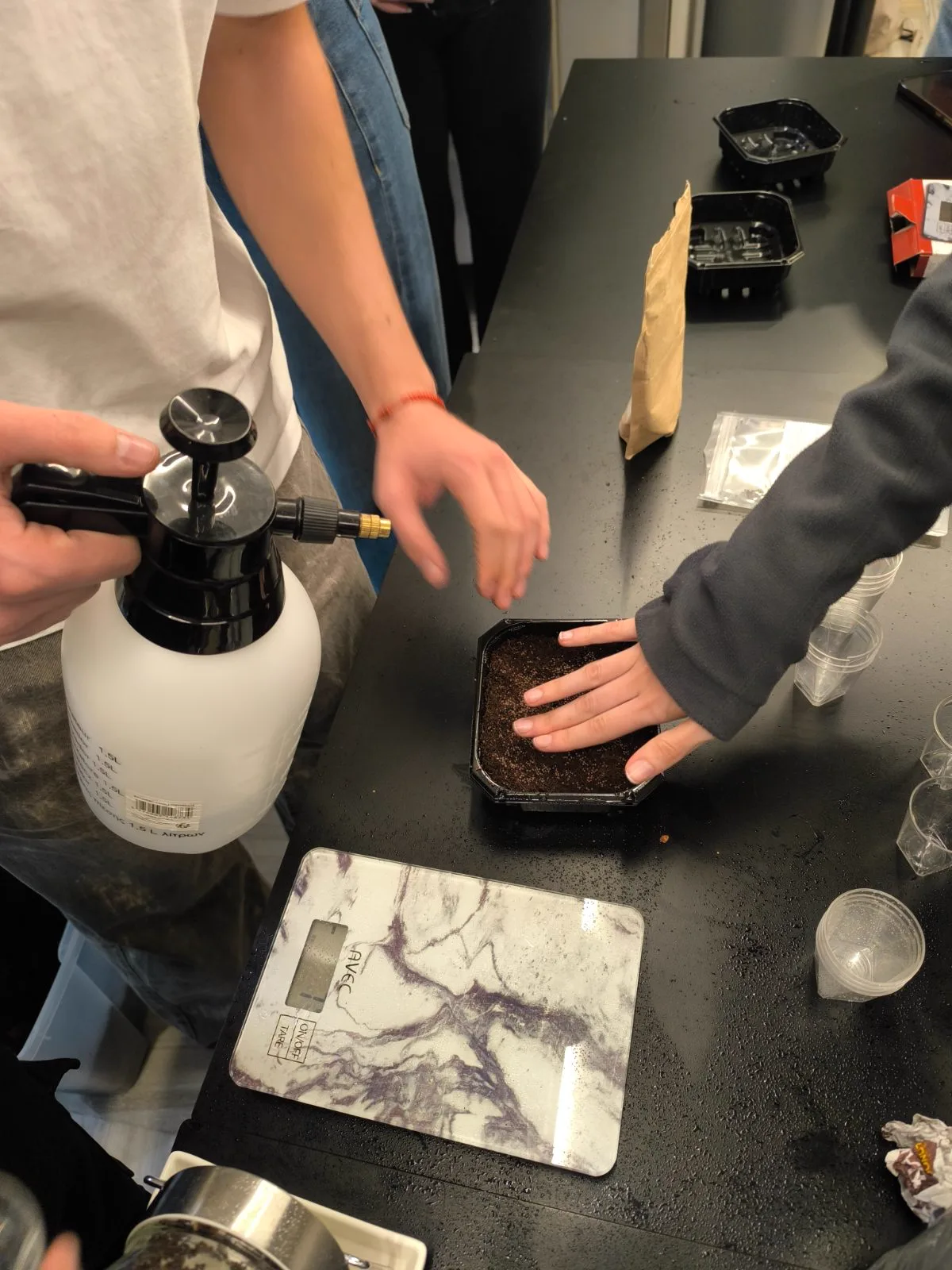
Participants run a complete, real microgreens cycle with their own hands — sow, blackout, light, measure, harvest, taste, and where it fits, cost and pitch the result. Because the crop is ready in days, a group closes the whole loop inside a single workshop or mobility, then reflects on what worked and tries again. It is learning by doing, with a result you can see, eat and be proud of.
Authored in our network, proven in Athens, arriving in Kocani. The methodology was written by Blagoj Ristov, president of EVEC Kocani, and piloted by our sister organisation EVEC Athens. We are now bringing it home to North Macedonia.
Why a tray teaches so much
Why microgreens are a near-perfect learning tool, in four parts.
Seed to harvest in 7–14 days, so participants experience the whole arc inside one activity and leave with a completed project — not an abandoned pot.
About €5, a windowsill or a basic LED, indoor and all-season, no land. It works in a youth centre, a classroom with no garden, or at a table for someone with limited mobility.
You taste and share what you grew. A lesson becomes a real product, which builds ownership and confidence an abstract worksheet never can.
Biology, the scientific method, maths and data, nutrition, sustainability and business — all in one activity, perfect for mixed-ability groups.
The skills participants can gain
Mapped to the EU competence frameworks evaluators actually use.
This is what makes microgreens fundable, not just fun: a single project develops competences across the frameworks behind the whole Erasmus+ agenda, and advances three horizontal priorities at once.
EntreComp — Spotting opportunities. “Use your imagination and abilities to identify opportunities for creating value.”
EntreComp — Mobilising resources. “Get and manage the material, non-material and digital resources needed to turn ideas into action.”
EntreComp — Taking the initiative. “Initiate processes that create value.” This is the only method here that closes the full arc — spot it, resource it, act on it, sell it — inside a single mobility, because the crop is finished in ten days.
GreenComp 4.3 — Individual initiative. “To identify own potential for sustainability and to actively contribute to improving prospects for the community and the planet.”
Key Competence: Entrepreneurship — from the Council Recommendation on Key Competences for Lifelong Learning, the framework behind Youthpass. Participants in Erasmus+ Youth and European Solidarity Corps activities can receive a Youthpass recording these competences.
This is not a horticultural qualification and not a route into agricultural employment. It is a microgreens production cycle short enough to finish, used to teach something else.
Run a near-zero-waste, water-efficient food system and measure yield-per-litre and food-miles avoided — sustainability you act out, not just read about.
The short cycle lets learners run several full idea-to-value loops — spot demand, cost trays, harvest, pitch a real sale. Learning real business concepts — not a promise of income.
Log germination and yield, automate light and watering, and create the promotion — a sales page, QR-labelled packaging and social content.
Daily care of a living crop builds routine, patience and resilience; growing in teams builds collaboration, communication and a growth mindset.
Outcomes describe what participants can gain, and depend on how the activity is run. EVEC Kocani hosts and facilitates as a partner NGO — activities lead to a certificate of participation / Youthpass-style recognition of non-formal learning, not a formal qualification. Nutrition and sustainability claims reflect external research, not EVEC findings, and we make no medical claims.
It already travels
The method, proven in a real project — by our network.
Delivered by our sister organisation · Erasmus+ Youth
Piloted in Athens, built to travel
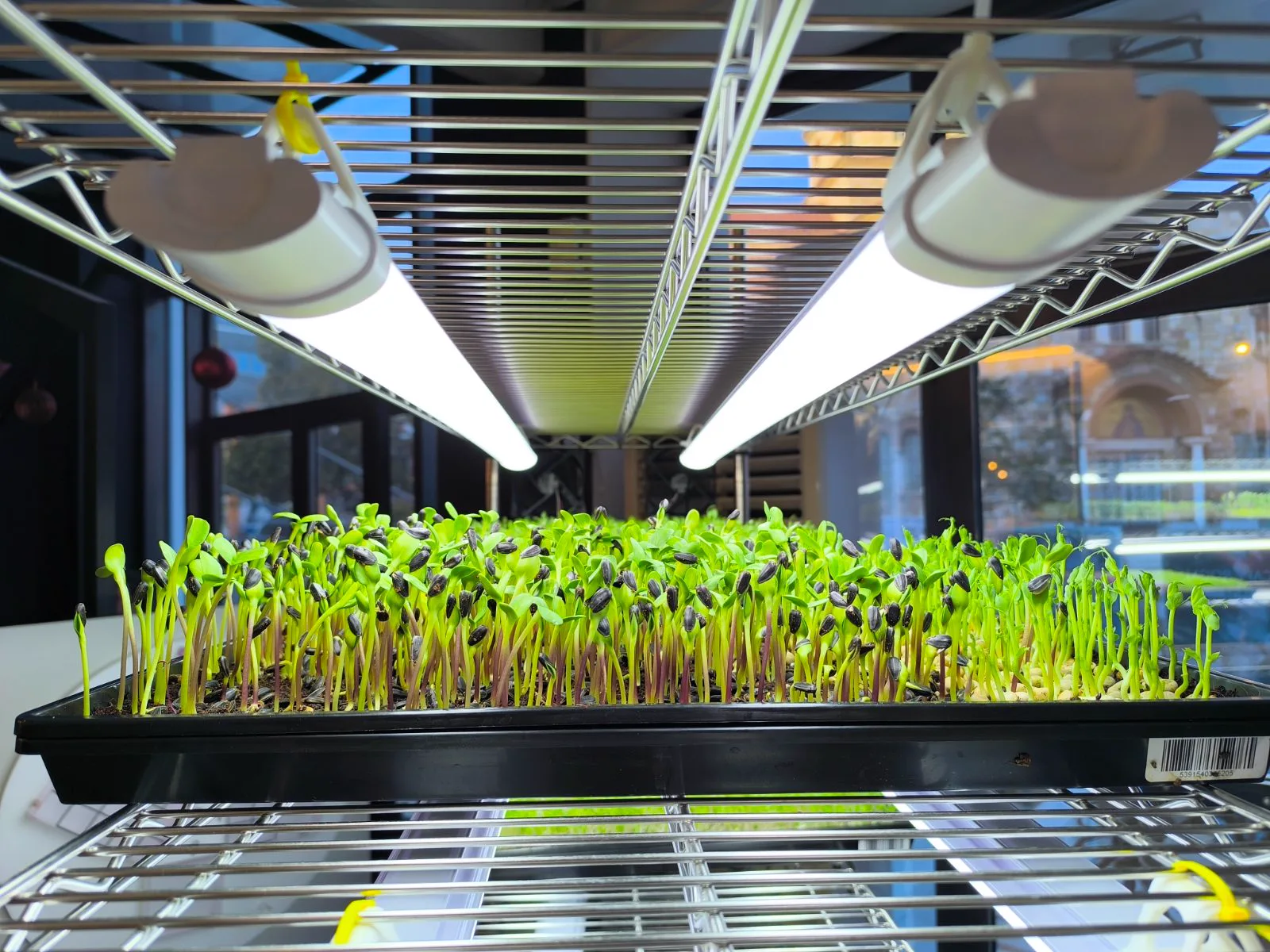
Our sister organisation EVEC Athens piloted the microgreens method through the Erasmus+ Youth mobilities it hosts, putting it in the hands of youth workers and volunteers from across Europe — who took it home to their own organisations. That Athens work is the foundation this page is built on, and proof the method transfers across borders and contexts. EVEC Stip, one of our branch offices, has itself taken part in EVEC Athens’ Erasmus+ Youth projects — this network is not a paper arrangement.
Honesty note: the delivered results above belong to our network in Athens, not to Kocani. Here we are at the start — we are bringing the method to North Macedonia now, and the first local groups will be pilots, not polished showcases. If you join early, you join as a co-builder.
For institutions & partners
Bring the microgreens method into an Erasmus+ project.
You bring the learners and the theme; we bring hosting in Kocani under our ESC Quality Label, the grow-and-learn method, and a network that has already delivered it in Athens. Here are example project ideas across the Erasmus+ fields we work in, from school education to adult education, to spark thinking — they are ideas, not past projects. When one fits, start the conversation through our Erasmus+ hub.
Youth
Tray to Table
Young people from two countries each run a real microgreens micro-enterprise from seed to first pitch in one short mobility, hosted in Kocani.
School Education
The 14-day classroom
Co-create a cross-curricular microgreens unit with partner schools — our members include teachers at Kocani’s “Green Flag” eco-school, Rade Kratovce.
Adult Education
Greens of Kocani
A week in Kocani for adult and senior learners blending the town with a sow-to-harvest cycle — sustainability and confidence.
VET
Growing bench
Hands-on agri-food skills for an incoming group — food hygiene, the sow-to-harvest protocol, post-harvest handling and supplying local kitchens.
Sport
Grow Stations
A no-gatekeeping squad activity pairing something living to tend with our inclusive Boccia sessions — we were the first organisation in North Macedonia to introduce the Paralympic sport.
Solidarity Corps
Grow crew, hosted
ESC volunteers help set up and run the first Kocani grow bench under our Hosting Quality Label — and turn each harvest into workshops for local youth.
For people
Or get your own hands in the trays.
Coming to do it yourself, rather than running it with your own group? There are four ways in: as a funded European Solidarity Corps volunteer for 2–12 months, as an intern through your university, through local volunteering if you are already in Kocani, or remotely through online volunteering — helping turn the method into materials other people can pick up and run.
Be clear about what you would be joining: the Kocani microgreens programme is being started now, so the first people in are helping to build it, not slotting into a finished machine. Every route ends with a certificate of participation and a reference. Local and online volunteering are unpaid. Find the one that fits through our Get Involved hub.
Internship
Grow & Teach
Help set up a real microgreens bench, log the germination and yield data, and turn each harvest into workshops for Kocani youth — leaving with a portfolio.
Local volunteering
The Kocani grow-crew
Sow, tend and harvest the greens that will feed our youth workshops. No garden or experience needed; flexible and unpaid.
Online volunteering
Grow it online
No garden needed — grow the reach. Help from anywhere: how-to guides, tray labels, the social channels, subtitles and a data template.
ESC
An ESC stay in Kocani
2–12 EU-funded months helping start the programme — accommodation, food, pocket money at the rates set by the current ESC rules for North Macedonia, travel, insurance, a Macedonian language course, a named personal mentor with regular one-to-one time and an emergency contact reachable outside office hours.
Where it stands
Honestly: what exists, and what doesn’t yet.
We would rather show you a truthful roadmap than photos of workshops that haven’t happened here yet. The pictures on this page come from our network’s work in Athens.
Method written and piloted
The microgreens methodology was authored by Blagoj Ristov and piloted by EVEC Athens through the Erasmus+ Youth mobilities it hosts.
Bringing it to Kocani
We are adapting the materials for local use and looking for the first partner school, youth group and volunteers in Kocani and our branch towns.
The first local cycle
A first sow-to-harvest cycle with a pilot group. Your class, club or organisation could be that group — early joiners shape how it runs here.
Want the how-to, the varieties and the science before you commit? Write to us and we’ll send you the right starting pack from our network’s library.
Email contact@evec.org.mk →Let's grow something
For the places that have nothing.
Most growing methods need something you may not have: land, a season, decent weather, somewhere outdoors it is safe to leave things unattended.
This needs a flat surface, water, and light through a window.
- A school with a concrete yard and no soil anywhere on site
- A classroom in February
- A youth centre with one windowsill and no outdoor access at all
- A tower block, a shelter, a room borrowed twice a week
Which makes it the one method here that works exactly where the others cannot. The question is not whether your setting is good enough. It is which of your groups has been told they cannot do practical work — because this is the one they can.
What is actually holding it up?
A microgreen takes almost everything it needs from the seed itself. Over ten days it barely feeds from what is underneath it at all. The medium is not nutrition — it is doing two jobs: holding water, and holding the plant upright.
Soil does that. So does coconut coir. So does a hemp mat, and so, at a push, does a sheet of kitchen paper.
So the real question is not what the best growing medium is. It is what, where you are, is already fine enough, clean enough, and holds water.
Run it in your town in North Macedonia.
Our network wants to establish a European community around these methods, and in North Macedonia that starts here: EVEC Kocani is the founding network member on this side of the border, and we are looking for schools, youth centres and organisations to build the Macedonian chapter with us — not to join something finished.
You don’t need any background in microgreens. The materials are built so a facilitator can run them without one.
We give — the method free; a walkthrough before your first cycle; the experience of a network that has already piloted it in Athens; co-authorship of whatever comes out of your pilot; and a say in what the Macedonian chapter becomes.
We ask — run it once, with one group, and tell us honestly what happened, including what didn’t work.
And if something occurred to you while you were reading this — tell us that instead. Some of the best projects our network has been part of started as somebody else’s idea, and we would rather join yours than talk you into ours.
No fee, no contract, no exclusivity. Minors take part with parental consent, per our safeguarding policy.
EVEC Kocani’s Erasmus+ and European Solidarity Corps projects are co-funded by the European Union. Views and opinions expressed are those of the author(s) only and do not necessarily reflect those of the European Union or the European Education and Culture Executive Agency (EACEA). Neither the European Union nor EACEA can be held responsible for them.
EVEC Kocani · European Voluntary and Educational Center Kocani · OID E10119353 · PIC 943554018 · ESC Quality Label (Hosting + Supporting) valid to 31/12/2027 — verifiable on the European Youth Portal (organisation 49665) · Kocani, North Macedonia.
Active since 2014 · 17 EU projects across our network · 4 branch offices. We have coordinated Erasmus+ ourselves — “Entrepreneurial Development Through Internet and Social Media”, 2020-1-MK01-KA102-077700 — verifiable on the Erasmus+ Project Results platform.
Methods by Blagoj Ristov, president of EVEC Kocani; piloted through our sister organisation’s hosted mobilities in Athens.
contact@evec.org.mk — we reply within 3 working days.
Two ways forward
For institutions
Erasmus+ partnerships
Every Key Action and field we partner on — start a project with us.
Go to the hub →For people
Get Involved
Internship, volunteering or a funded ESC placement — find your way in.
Go to the hub →Talk to us
Contact EVEC Kocani
One honest e-mail is enough to start — we reply within 3 working days.
Go to contact →