An EVEC Kocani Sport initiative · For Erasmus+ Sport partners, schools, day-care centres & youth NGOs
Inclusion through sport — starting with Boccia.
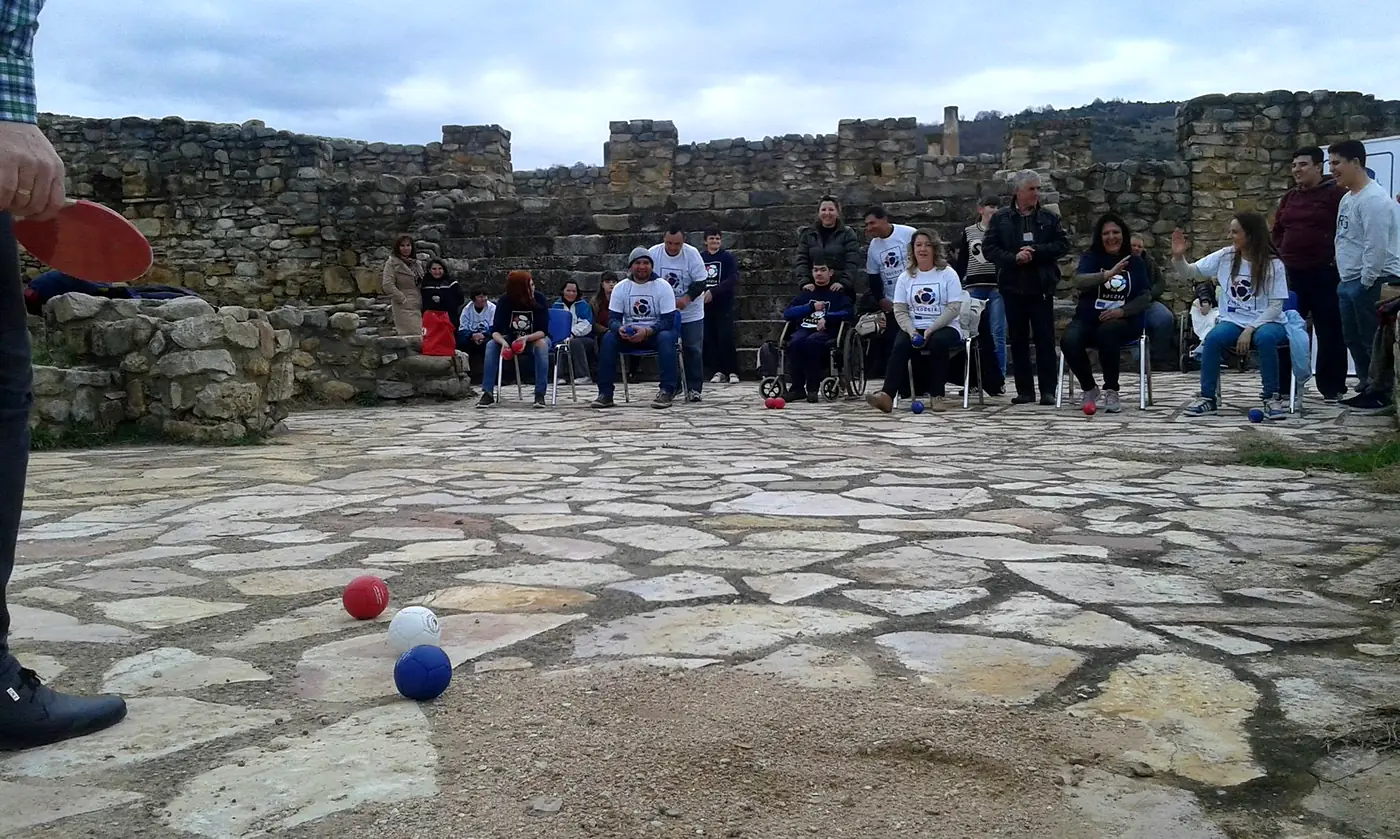
We were the first organisation in North Macedonia to introduce the Paralympic sport Boccia — a precision ball game where disabled and non-disabled people play together, on level terms, in any hall. We have two trained Boccia trainers, specialists among our members and charity sport matches behind us. Build inclusive sport with us as your Erasmus+ Sport partner, or simply invite us for a first session.
Why Boccia, why here
A real Paralympic sport — and the fairest game a hall can host.
Boccia isn't an adapted version of somebody else's sport. It was designed from the start for people with severe motor impairments, it has its own Paralympic history, classes and rulebook — and it happens to be one of the cheapest team sports a school or day-care centre can start.
A Paralympic sport
Boccia has been on the Paralympic programme since 1984, governed by World Boccia, with its own classes, rulebook and international championships.
Inclusive by design
Created for athletes with cerebral palsy and severe motor impairments — ramps and on-court assistants keep the game open at every level of impairment.
First in North Macedonia
EVEC Kocani was the first organisation in the country to introduce Boccia — and has two trained Boccia trainers on the team.
Cheap and hall-ready
A set of balls and any flat indoor floor. No special venue, no expensive kit, no travel needed to start playing.
The model
One pathway, four levels — from a first throw to real competition.
We don't start with classification paperwork and tournament brackets. We start with one session anyone can join, grow it into a weekly group, connect it to the community sport we already run — and let the players who want more climb toward competition.
Competitive Boccia
Match play under the Paralympic rulebook — local tournaments first, then national and cross-border competition for the players who want it.
A weekly Boccia group
Trainer-led sessions with ramps and adapted kit where needed — run by our two trained Boccia trainers, in your hall or ours.
Community sport
The charity sport matches we already run with the community — the local sporting base that Boccia joins, bringing the whole town onto one pitch.
A first throw
A one-session demonstration day at a school or day-care centre. We bring the balls and a trainer; everyone plays from the first minute.
The anchor discipline
Boccia — the sport where everyone genuinely plays together.
Boccia is a precision ball sport, a close cousin of pétanque. Each side plays six coloured balls as near as possible to a white target ball — the jack — throwing, kicking or releasing them down a ramp. It is played seated, on any flat indoor court, and it was designed for people with cerebral palsy and other severe motor impairments. Calm, tactics and touch decide the game — not strength or speed.
That design makes it the rare sport where disabled and non-disabled people play in the same session, on level terms. It needs no special venue — a school hall, a day-care centre common room or a gym floor is enough. And we run it with people who know the audience: our members include special-education teachers, psychologists, pedagogues, social workers and nurses from the day-care centres our network works with.
Seated · indoor · everyone plays
- Played seated — wheelchair users compete on level terms
- Ramps and assistants keep entry open at every impairment level
- Precision and tactics, not strength or speed
- Disabled and non-disabled people share one court
- A recognised Paralympic rulebook to adopt
We were first. EVEC Kocani was the first organisation in North Macedonia to introduce Paralympic Boccia — and has two trained Boccia trainers on the team. Now we want partners to help it grow: across the country, and across borders under Erasmus+.
Build it with us →Start with what you have
Three sizes of "yes" — from one afternoon to a match-ready club.
The biggest barrier to inclusive sport is the belief that it needs a special venue and a big budget. Boccia doesn't. Every tier below starts with the hall and the people you already have — we bring the kit, the trainers and the method.
A first session
A demonstration day at your school, day-care centre or youth club. We bring the ball sets and a trained trainer; everyone — players, staff, parents — plays.
your hall, our kitA regular Boccia group
Trainer-led weekly sessions, with ramps and simple adapted equipment where needed, and your own staff learning to run the game alongside our trainers.
trainer-ledA match-ready club
Full ball sets, court markings and match play under the Paralympic rulebook — ready to host local tournaments and charity matches.
match-readyNo price list here, on purpose. We won't publish figures we'd have to invent. We plan each setup with you around the space, the people and the support you already have — and we say plainly what has to be bought and what doesn't.
Partner with us
We brought Boccia to North Macedonia — now we want to grow it with partners.
We're not claiming to run a national league. We're the organisation that introduced the sport here, and we want committed partners — schools, day-care centres, youth NGOs, sports clubs, municipalities and European organisations — to build inclusive sport with us.
EVEC Kocani brings the trainers, the specialist members and the delivery record; Boccia already has a neutral Paralympic rulebook. Together we adopt it, take it to the places where people already are, and grow an inclusion-through-sport network — local first, then cross-border.
What EVEC Kocani brings as your Erasmus+ Sport partner
Reliable EU delivery
17 EU projects across our network since 2015, and an ESC Quality Label valid to 2027. We deliver our work packages.
Two trained Boccia trainers
Ready to lead sessions, train facilitators and run the game under the Paralympic rulebook — at the organisation that introduced the sport to the country.
Specialist members
Special-education teachers, psychologists, pedagogues, social workers and nurses — inclusion is our daily work, not a slogan.
Day-care centre experience
Long-running work in day-care centres for people with disabilities across our network — Stip, open since 2006, and Delcevo, open since 2004.
Sport that already runs
Charity sport matches with the community, run in cooperation with the Red Cross — sport that already brings the whole town together.
What we'd build together
The work behind each line
The list above is short on purpose. Here is the work behind each line, so you can weigh the load before agreeing to carry any of it as an Erasmus+ Sport partner.
Boccia demonstration days
A one-session format any school, day-care centre or youth club can host: we arrive with ball sets and a trainer, everyone plays within minutes, and staff see with their own eyes that the sport fits their hall and their people. It is the cheapest possible way to find out whether you want more.
A facilitator-training route
A short non-formal route, led by our two trained Boccia trainers, so a PE teacher, a youth worker or a day-care carer can run sessions confidently without first becoming a Paralympic official. A sport that depends on two people in one town does not scale; training facilitators is how it does.
An adapted-equipment & venue checklist
What a hall actually needs — floor, court markings, ball sets, ramps, seating — written down once, plainly, so a partner can prepare a venue without guesswork and without buying things the game does not need.
Inclusive sessions where people already are
Boccia goes to the day-care centres, schools and youth clubs — not the other way round. Our members work in the day-care centres for people with disabilities open since 2004 in Delcevo and 2006 in Stip; taking the sport to those rooms is the point of the whole page.
Local tournaments & charity matches
We already run charity sport matches; Boccia joins that calendar. Local tournaments give a weekly group something to train for, and a charity match puts disabled and non-disabled players in front of the same crowd — which changes minds faster than any leaflet.
A safeguarding & consent pack
Risk-assessment templates, parental-consent forms for minors, and plain-language session rules — aligned with our safeguarding policy. When you work with children and with people with disabilities, this is the first thing to write, not the last.
How it's funded
Fundable through Erasmus+ — framed honestly.
Inclusion and diversity is a priority across the whole Erasmus+ programme, and "education in and through sport" with a genuine disability-inclusion dimension is exactly where a Boccia partnership fits. We frame bids on inclusion and participation — not on health claims.
Small-scale Partnership
Newcomer-friendly by design. Pilot the demonstration days, the facilitator training and the first inclusive groups across a couple of countries.
2+ countries · grant set by current Erasmus+ rulesCooperation Partnership
The bigger build: the facilitator-training route, the equipment and venue standards, tournaments and cross-border exchanges.
3+ countries · grant set by current Erasmus+ rulesHonest by design. We'd lead a bid on inclusion, participation and education in and through sport — not health claims — and adopt the recognised Paralympic rulebook rather than inventing our own. Grant levels and deadlines are set by the current Erasmus+ rules for North Macedonia; if a round comes too soon, we aim for the next one.
How this works
From first e-mail to first match — the order we work in.
Nothing here asks you to decide everything at once. This is the order we work in with a new partner, and you can stop after any step and still be left with something your people can use.
Tell us who you are
Write to contact@evec.org.mk: who you are — school, day-care centre, youth NGO, sports club, municipality or European partner — what indoor space you have, and roughly how many people. We reply within 3 working days.
We plan honestly
No invented price list, no invented numbers. We plan the setup around the hall, the people and the support you already have — and we say plainly what is new for us too, because Boccia is young in this country and pretending otherwise helps nobody.
A first session before any paperwork
We bring the ball sets and a trained trainer; you bring your people. One demonstration day shows players, parents and staff what Boccia is — while any application is still being written.
Pick the instrument that matches your ambition
A Small-scale Partnership suits a first-time Erasmus+ Sport partner, or a pilot of demonstration days and facilitator training across a couple of countries. A Cooperation Partnership is the bigger build — training routes, standards, tournaments and exchanges across three countries or more.
Write the bid together, framed honestly
Inclusion, participation and education in and through sport — not health claims. We bring the trainers, the specialist members and the delivery record; you bring the local reality that makes an application believable. Grant levels are set by the current Erasmus+ rules for North Macedonia.
Grow into matches and exchanges
Regular club sessions first, then local tournaments and charity matches, then cross-border exchanges for the players and facilitators who want them. Each stage stands on its own — none of them requires the next.
We don't set the calendar — Erasmus+ does. How long a project runs, and how long any activity inside it lasts, is fixed by the Erasmus+ rules for the action you apply under and by the grant agreement you sign. We are not inventing rules. Tell us the dates that fit your year and we build the plan around them.
Be honest early
Who this is for — and who it honestly isn't.
Saying no early saves everyone a funding round. Here is where an inclusion-through-sport partner fits with us, and where you would be better served by someone else.
A good fit
- Day-care centres and special-education settings. Boccia was designed for your people — and our members work in the day-care centres for people with disabilities in Delcevo and Stip, open since 2004 and 2006.
- Schools with any indoor hall. One flat floor is enough, and disabled and non-disabled pupils play in the same session — inclusion you can see, not a poster.
- Youth NGOs doing non-formal work. A calm precision sport with a low entry barrier: inclusion, teamwork and patience in one session.
- Sports clubs and municipalities. A Paralympic discipline still young in North Macedonia — easier to help shape now than after it has settled.
- Newcomers to Erasmus+. The Small-scale Partnership is newcomer-friendly by design, and we have written and delivered EU projects since 2015.
Probably not a fit
- You want a national league to join next month. We won't claim one exists. What exists today: the first trainers, the kit, the sessions — and an open invitation to build the rest.
- You need elite performance coaching. We run grassroots, inclusion-first sport. Classification-level competition is the later phase, not the entry point.
- You want a fitness programme with health claims. We frame sport as inclusion and education, and we will not write health claims into a bid.
- You want a supplier, not a partner. A partner takes work packages and delivers them — and that runs in both directions.
- You want big numbers on a slide. We publish reference codes you can verify, and we say plainly what is new. If a pitch needs invented statistics, it isn't ours.
Want to try Boccia?
In Kocani or beyond — we'll bring the ball sets and a trained trainer for a one-session demonstration day, and help you grow it into a weekly group when you're ready. Start small; everyone plays from the first minute. We are also looking for European Solidarity Corps volunteers — our ESC Quality Label is held by the association, so a placement can be based in any of our five towns: Kocani, Stip, Strumica, Delcevo or Lozovo.
Questions we get
The questions every new partner asks first.
Straight answers, in roughly the order people actually ask them.
What is Boccia, in one paragraph?
A precision ball sport related to pétanque, played seated on any flat indoor court. Each side plays six coloured balls as close as possible to a white target ball called the jack — throwing, kicking or releasing them down a ramp. It was designed for people with cerebral palsy and other severe motor impairments, and ramps and on-court assistants keep it open at every level of impairment.
Is Boccia really a Paralympic sport?
Yes. Boccia has been on the Paralympic programme since 1984 and is governed by World Boccia, with its own classification system, rulebook and international championships — one of the few Paralympic sports with no Olympic counterpart. We adopt that rulebook rather than inventing our own.
Were you really the first in North Macedonia?
Yes. EVEC Kocani was the first organisation in North Macedonia to introduce Paralympic Boccia, and we have two trained Boccia trainers on the team.
Do participants need experience, fitness or equipment?
No. Boccia asks for touch and tactics, not strength or speed. We bring the ball sets and a trainer; a flat indoor floor is all the venue you need. People play from the first minute of the first session.
Can disabled and non-disabled people really play together?
Yes — that is the point of the sport, and of this page. Boccia's design lets wheelchair users, people with high support needs and non-disabled players share one court on level terms. That is why we built our inclusion-through-sport work around it, rather than adapting a sport that was never designed for everyone.
What does an Erasmus+ Sport partner actually commit to?
Work packages, and delivering them: hosting demonstration days and sessions with your own people, taking part in the facilitator training, reporting back what works and what breaks, and taking a named share of the writing — the training route, the equipment checklist, the tournaments or the exchanges.
What about children and young people under 18?
Minors take part with parental consent, per our safeguarding policy. Sessions are run by members who are special-education teachers, psychologists and pedagogues, and consent and risk-assessment paperwork is part of every session plan — not an afterthought.
What does it cost?
We won't publish a price list we'd have to invent. A first session needs the kit we bring and the hall you already have. If we apply for funding together, grant levels are set by the current Erasmus+ rules for North Macedonia — and honest, unpaid work from both sides is what actually gets the first session on the floor.
How long would a project run?
That is not ours to decide, and we would rather say so plainly. The Erasmus+ rules for the action you apply under, and the grant agreement you sign, set how long the project and any activity inside it last. Tell us the dates that fit your year and we build around them.
How fast do you reply, and can we visit?
We reply within 3 working days, every time — write to contact@evec.org.mk. Our seat is at Ul. Boris Trajkovski 42, 2300 Kocani, North Macedonia; e-mail first and we'll arrange a time that suits you, rather than publishing office hours we would then have to break.
Trust & credibility
A young sport here — backed by a real, EU-recognised organisation.
Boccia is new to North Macedonia; what isn't new is EVEC. Active since 2014 · 17 EU projects across our network · 4 branch offices · ESC Quality Label valid to 2027 — and every claim below carries a reference you can verify yourself.
ESC Quality Label
Hosting + Supporting — verifiable on the European Youth Portal.
Valid to 31/12/2027Organisation IDs
Our official identity in the EU system.
OID E10119353 · PIC 943554018Registered NGO
Citizens' association founded 15.02.2014, entered in the Central Registry of RNM on 11.03.2014.
EMBS 6938566 · EDB 4013014510973Proven track record
17 EU projects across our network since 2015 (Kocani 5 · Stip 8 · Delcevo 5; one joint project counted once) — as coordinator, an Erasmus+ VET mobility, 2020–2022. Verify any code on erasmus-plus.ec.europa.eu.
2020-1-MK01-KA102-077700First in Boccia
The first organisation in North Macedonia to introduce the Paralympic sport — with two trained Boccia trainers.
2 trained Boccia trainers · Paralympic rulebookKocani, North Macedonia
Ul. Boris Trajkovski 42, 2300 Kocani — with branches in Stip, Strumica, Delcevo and Lozovo.
contact@evec.org.mk
 Co-funded by the European Union
Co-funded by the European Union. Views and opinions expressed are however those of the author(s) only and do not necessarily reflect those of the European Union or the European Education and Culture Executive Agency (EACEA). Neither the European Union nor EACEA can be held responsible for them.
Let's begin
Let's get the first ball rolling. Tell us who you are.
Whether you're a potential Erasmus+ Sport partner, a school, a day-care centre, a youth group or a sports club — tell us where you'd start and we'll come back to you within 3 working days. If you would rather take part yourself than partner with us, see the ways to get involved.
Write to us
Tell us who you are — school, day-care centre, youth NGO, sports club, municipality or European partner — what indoor space you have, and roughly how many people. We reply within 3 working days.
contact@evec.org.mk