Our hands-on methodology · Erasmus+ & European Solidarity Corps
Mycelium as an educational tool.
Fungal mycelium — the living root-web behind every mushroom — turns farm waste into food, biomaterials and a hands-on lesson in green, digital and entrepreneurial skills. Our network piloted the method in Athens on the olive prunings Greek farmers burn every winter; we are now bringing it home to Kocani, where every rice harvest leaves straw behind. Here is how it works across every Erasmus+ field, and how you can take part.
New to mycelium? Start here
You don’t need to know anything about mushrooms. The mycelium method is built so a facilitator can run it without a background in mycology. If you’ve run a workshop, you can run this.
These are European methods. They need nothing a town like Kocani doesn’t already have.
Nature's answer to styrofoam — grown from waste in a week.
Mushrooms are only the fruit. The real organism is mycelium — a dense web of living, root-like threads that spreads as it feeds, and glues whatever it grows through into one solid mass. We put that quiet superpower to work.
From a waste pile to a building block — in five steps
Take the waste
Rice straw from the Kocani valley — or any farm leftover: maize stalks, vine prunings, sawdust, husks.
Chop & fill a mould
Shred it small, mix in mycelium, and pack it into a mould — any shape you want.
Let it grow ~7 days
The mycelium eats through the waste and binds it solid, taking the exact shape of the mould.
Bake it
A gentle heat stops the mycelium growing and locks the shape for good.
It's a material
Light and rigid like styrofoam — ready for packaging, insulation and more.
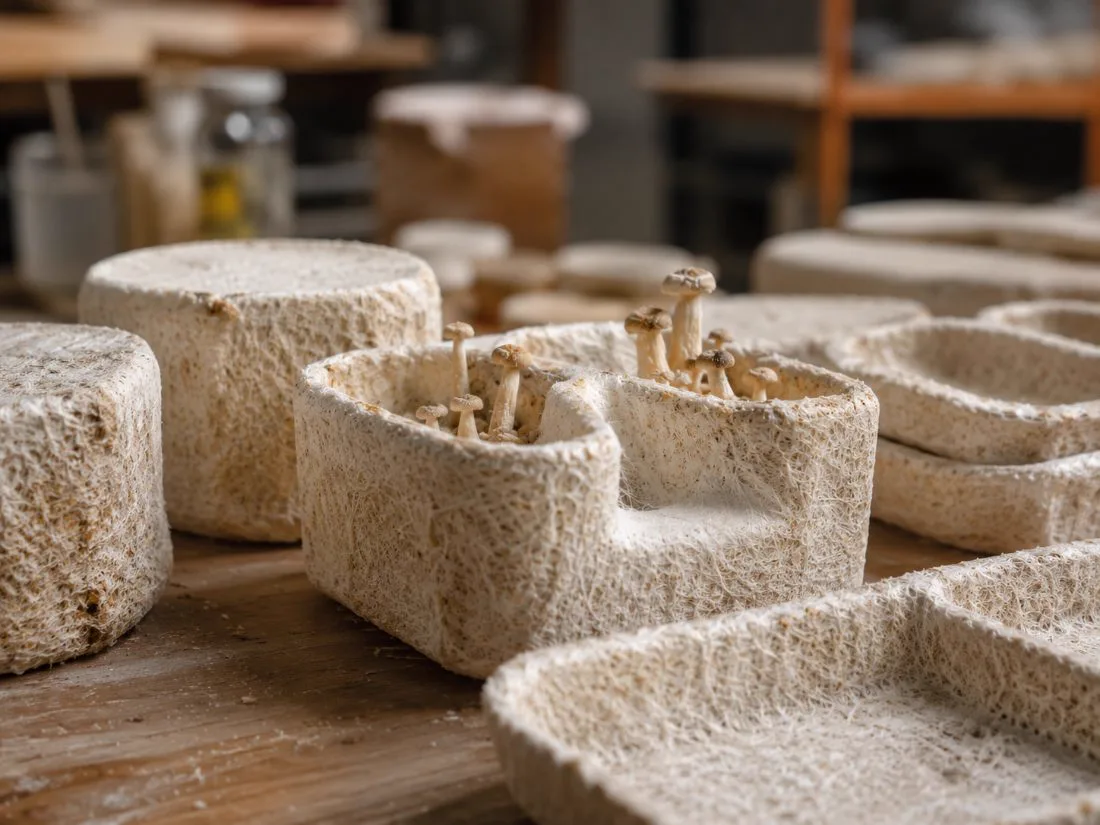
Mushroom foam grown from waste
- Grown from free farm waste, not oil
- Light and rigid — does styrofoam's job
- Naturally water-resistant
- Chars instead of melting — safer in a fire than plastic foam
- Composts back into the soil in weeks
Styrofoam (EPS) drilled from oil
- Made from oil and plastic
- Melts and drips in a fire
- Never biodegrades — lingers for centuries
- Piles up in landfills and washes into rivers
- Can never go back to the earth
Same job, opposite footprint. We grow the packaging — we don't drill for it.
And here is the point for educators: a learner who grows a single mycelium brick has quietly done biology (how a fungus digests waste), materials science (a real composite), design (the mould), data (measuring the growth) and business (a product people actually want) — and walks away holding the proof. That is exactly why we use it as a teaching tool.
Why a fungus teaches so much
A near-perfect learning tool — for one simple reason in four parts.
Mycelium is not a gimmick we picked at random. As a teaching vehicle it starts from a real local problem, runs on free waste, ends in something you can hold, and crosses half the curriculum — which is exactly why the same method works for a school class, an adult group, a vocational mobility or an international youth exchange.
A real problem, in their hands
Every autumn the harvest leaves straw, stalks and prunings behind — residues that are often burned or dumped. Learners start from that real, local problem — smoky air and wasted biomass — and turn it into something useful. Problem-based learning that actually motivates.
Built from free waste
The raw material is straw and prunings that would otherwise be burned or thrown away — abundant, local and free. Cost is never the barrier: it works in a school with no garden, a youth centre or a community space.
Two harvests you can hold
One waste stream yields food — gourmet and medicinal mushrooms — and materials — biodegradable mycelium packaging, insulation and design objects. A lesson becomes a real product, which builds ownership and confidence.
One organism, many subjects
Biology, chemistry, the scientific method, data, design, sustainability and business — all in one activity. Ideal for mixed-ability, mixed-interest groups working side by side.
Mycelium is a proven method used by educators, designers and scientists worldwide — not something we invented. We don't have a lab in Kocani yet: we are starting the programme now, and the deep how-to library is being adapted for North Macedonia by our network — write to us for the starting pack. It sits alongside our other hands-on tools: microgreens, drones and solar.
The skills participants can gain
Mapped to the EU competence frameworks evaluators actually use.
This is what makes mycelium fundable, not just fascinating. A single project develops competences across the frameworks behind the whole Erasmus+ agenda — and advances all four horizontal priorities at once.
GreenComp 2.1 — Systems thinking. “To approach a sustainability problem from all sides; to consider time, space and context in order to understand how elements interact within and between systems.” Learners follow one waste stream from a rice field to a finished object, and see where it goes next.
GreenComp 2.3 — Problem framing. “To formulate current or potential challenges as a sustainability problem in terms of difficulty, people involved, time and geographical scope, in order to identify suitable approaches to anticipating and preventing problems, and to mitigating and adapting to already existing problems.” The starting point is a real local problem — crop residue that gets burned or dumped — not a hypothetical.
Key Competence: STEM — from the Council Recommendation on Key Competences for Lifelong Learning, the framework behind Youthpass. Participants in Erasmus+ Youth and European Solidarity Corps activities can receive a Youthpass recording these competences.
GreenComp
Green skillsTurn a burned-waste problem into a closed-loop circular system — divert biomass from burning, design for compostability, and measure the environmental gain. Sustainability you act out, not just read about.
EntreComp
EntrepreneurshipCost a substrate batch, prototype a mycelium product and pitch a venture — learners run real idea-to-value loops. Learning real business concepts — not a promise of income.
DigComp 2.2
Digital skillsLog colonisation and yield data, document the process, design composite moulds, and build the promotion — a portfolio, QR-labelled packaging and social content.
LifeComp
Wellbeing & soft skillsLong grow-cycles build patience, routine and resilience; growing in teams builds collaboration, communication and a growth mindset — and learning from contamination builds grit.
Key Competences
STEM & breadthOne organism honestly touches biology, chemistry, maths and data, design, sustainability and business — the transversal breadth the 2018 key-competence framework is built around.
All 4 priorities, 1 activity
Erasmus+One project advances the green transition, digital transformation, inclusion and participation — the horizontal priorities every application is scored against.
Outcomes describe what participants can gain, and depend on how the activity is run. EVEC Kocani hosts and facilitates as a partner NGO — activities lead to a certificate of participation / Youthpass-style recognition of non-formal learning, not a formal qualification. The Kocani programme is being started now; figures such as crop-residue volumes and pollution levels are external estimates, not EVEC findings, and we make no medical claims.
Door A · for organisations
Co-design a mycelium project in your field.
You bring the learners and the theme; we bring hosting in Kocani under our ESC Quality Label, the mycelium grow-and-learn method, and a network that has already piloted it in Athens. Here is one concrete project seed for every field — they are ideas to build together, not past projects. Each links to that field's page, where the conversation starts.
Erasmus+ Youth
From Straw to Structure: a circular-economy exchange
Young people from several countries turn rice straw — left behind after every Kocani harvest — into mushroom harvests and grown-material objects, then take a zero-waste action home. One short youth exchange, all four priorities.
Build a Youth project →School Education
Stubble fields to living classrooms
Co-create a cross-curricular STEAM unit and an open, multilingual toolkit where pupils grow mushrooms and biomaterials from local crop residue — our members include teachers at Kocani's "Green Flag" eco-school, Rade Kratovce.
Build a School project →Adult Education
From waste to work: a green upskilling pathway
A low-barrier pathway where adults gain green and entrepreneurial skills growing mushrooms and materials from local agricultural waste, then pass those skills on in their own communities.
Build an Adult project →VET
FUNGI-VET: rice straw to bio-based skills
Host incoming VET learners for hands-on biofabrication — substrate prep, clean inoculation, quality control and moulding mycelium composites — with clearly described learning outcomes.
Host a VET mobility →Sport
MoveMyco: active trails, living materials
Pair outdoor walks that gather crop residue with building a mycelium grow-station — physical activity, teamwork and green skills for all, alongside our inclusive Boccia sessions: we were the first organisation in North Macedonia to introduce the Paralympic sport.
Build a Sport project →European Solidarity Corps
Grow crew, hosted
ESC volunteers help set up and run the first Kocani grow benches under our Hosting Quality Label — and turn each build and harvest into workshops for local youth.
Host with us →Door B · for individuals
Get your own hands in the substrate.
Not an organisation? You can still work with mycelium directly — and help start the Kocani programme from the first batch of substrate — as an intern, a local or online volunteer, or a fully EU-funded ESC volunteer. Be clear about what you would be joining: the programme is being started now, so the first people in are helping to build it, not slotting into a finished machine. Every route ends with a certificate of participation and a reference. Local and online volunteering are unpaid.
Internship
A field-matched mycelium traineeship
Join us in Kocani on a traineeship shaped around your field — biofabrication, biomaterial design, comms or coordination — and help start the programme under a Learning Agreement.
Apply for a traineeship →Local volunteering
The Kocani build-crew
Live in or near Kocani? Help start the programme from the first batch of substrate — shred, prep, inoculate, tend the grows and run harvest days and neighbourhood workshops. No experience needed.
Join the build-crew →Online volunteering
Grow it online
No need to be in Kocani — help build the open multilingual toolkits, translate the curriculum, design graphics or run social media, from anywhere.
Volunteer online →European Solidarity Corps
Build, grow, belong: an ESC placement
2–12 EU-funded months in Kocani helping start and run the mycelium programme and lead community workshops. Accommodation, food, an allowance at the rates set by the current ESC rules for North Macedonia, travel, insurance, a Macedonian language course, a named personal mentor with regular one-to-one time and an emergency contact reachable outside office hours are covered.
Apply to volunteer →How the method works
One waste stream, a closed loop.
No lab photos from Kocani yet — we are starting the programme now, and this space will fill with real builds and harvests. Here is the mycelium loop your learners run, hands-on, at every step.
Waste
Rice straw and farm leftovers that would otherwise be burned or dumped.
Substrate
Chopped & pasteurised into fungal feedstock.
Mycelium
Fungal threads colonise and bind it solid.
Food & material
Mushrooms to eat; composites to mould.
Compost
Spent substrate breaks down — nothing wasted.
Soil
Compost returns to the field. The loop closes.
↻ Waste → Substrate → Mycelium → Food & Material → Compost → Soil — and back again.
Real photos from our first Kocani builds and harvests will appear here as the programme takes shape — follow along, or come and help build it. The picture at the top of this page shows the method itself: mycelium colonising trays of shredded farm waste.
Go deeper
Want the full method before you commit?
The mycelium curriculum, build guides, project seeds and the science live in our network's open method library, and we are adapting them for North Macedonia now. Write to us and we'll send you the right starting pack for your group — and let you know as each piece goes live here.
Let's grow something together
Every region throws something away. Ours grows rice.
This works in any town — because it runs on whatever that town already throws away.
In Greece, where our network piloted the method, the problem is olive prunings: every winter the groves are cut back and the branches are burned in the field because there is nothing else to do with them. In the Kocani valley the obvious stream is rice straw, left behind after every harvest — a waste stream sitting right on our doorstep.
And it is not only ours. Across North Macedonia and the Balkans the same problem simply changes shape depending on where you stand:
- Rice straw — the Kocani valley, right here
- Vine prunings — Tikves and every other wine region, cut back each winter
- Maize stalks and cobs — across the plains
- Cereal straw — wheat and barley fields
- Sunflower stalks and husks — the eastern growing regions
- Fruit-tree prunings — apple around Prespa; plum, cherry and peach elsewhere
- Nut shells — walnut, hazelnut, almond
- Sawdust and forestry residue — from every sawmill town
- Urban streams — spent coffee grounds, brewery grain, cardboard: no farmland required
Open burning of crop residue is restricted across much of Europe, and it remains a serious air-quality problem in farming regions. Every one of these residues is somebody's disposal cost.
We are not going to tell you which of these works best. Our network knows what olive prunings do in Greece. Straw, sawdust, coffee grounds and brewery grain are well established for growing mycelium; woody prunings need chipping and behave differently again. What your local residue does — how it needs preparing, how fast it colonises, what it makes — is genuinely an open question.
That is not a gap in the method. That is the interesting part, and it is what a pilot is for. Your town brings a waste stream, and your learners get a problem that belongs to their own community rather than someone else's.
One honest practical note: residue does not go from the field into a mould. It has to be cut down, often milled, and usually pasteurised so nothing else colonises it first. That is the step that takes energy — and in most farming regions, the residue is sitting a long way from the nearest socket. The limiting factor is rarely the residue. It is having power where the residue is.
Run it with us in North Macedonia.
Our network wants to establish a European community around these methods, and in North Macedonia that starts here: EVEC Kocani is the founding network member on this side of the border, and we are looking for schools, youth centres and organisations to build the Macedonian chapter with us — not to join something finished.
You don't need any background in mycelium. The materials are built so a facilitator can run them without one.
We give — the method free; a walkthrough before your first cycle; the experience of a network that has already piloted it in Athens; co-authorship of whatever comes out of your pilot; and a say in what the Macedonian chapter becomes.
We ask — run it once, with one group, and tell us honestly what happened, including what didn't work.
And if something occurred to you while you were reading this — tell us that instead. Some of the best projects our network has been part of started as somebody else's idea, and we would rather join yours than talk you into ours.
No fee, no contract, no exclusivity. Minors take part with parental consent, per our safeguarding policy.
EVEC Kocani’s Erasmus+ and European Solidarity Corps projects are co-funded by the European Union. Views and opinions expressed are those of the author(s) only and do not necessarily reflect those of the European Union or the European Education and Culture Executive Agency (EACEA). Neither the European Union nor EACEA can be held responsible for them.
EVEC Kocani · European Voluntary and Educational Center Kocani · OID E10119353 · PIC 943554018 · ESC Quality Label (Hosting + Supporting) valid to 31/12/2027 — verifiable on the European Youth Portal (organisation 49665) · Kocani, North Macedonia.
Active since 2014 · 17 EU projects across our network · 4 branch offices. We have coordinated Erasmus+ ourselves — "Entrepreneurial Development Through Internet and Social Media", 2020-1-MK01-KA102-077700 — verifiable on the Erasmus+ Project Results platform.
Methods by Blagoj Ristov, president of EVEC Kocani, developing them since 2025; piloted through our sister organisation's hosted mobilities in Athens.
contact@evec.org.mk — we reply within 3 working days.
Related
All Erasmus+ partnerships
See every field and Key Action we partner on — Youth, School, Adult, VET and Sport.
View pages →Get involved as a person
Internship, local and online volunteering, or a funded ESC placement — find your way in.
View page →Microgreens — our other tool
Our flagship hands-on methodology: one low-cost tray that builds green, digital and entrepreneurial skills.
See the method →