Horizon Europe · Communication, Dissemination & Exploitation
The engagement partner your Impact section is missing — in eastern North Macedonia
EVEC Kocani is a civil-society organisation in a Widening country fully associated to Horizon Europe, embedded in five towns most consortia will never reach. We join proposals as a Horizon Europe partner on the impact side: communication, dissemination, exploitation, and genuine citizen and youth engagement with groups that proposals routinely call hard to reach. We have never been in a Horizon Europe consortium — that is stated plainly further down this page, before you ask.
Read this before anything else
This would be our first Horizon Europe consortium. We are not going to pretend otherwise.
EVEC Kocani has no Horizon Europe project experience of any kind — no beneficiary role, no third-party role, no associated partner role, nothing. If your call for partners requires demonstrated Horizon delivery, we do not meet it, and you should stop reading here rather than discover that at the consortium agreement stage.
What we are is different, and worth two more minutes. We are a citizens' association founded in 2014 that has spent eleven years delivering EU-funded projects under Erasmus+ and the European Solidarity Corps — seventeen of them across our network, one of which we coordinated end to end with our National Agency, from application to final report. We know what a grant agreement is, what a reporting deadline does to a project, and what happens when a partner treats dissemination as an afterthought.
So what a coordinator is actually adding is this: a partner who is new to Horizon reporting, but not new to EU project delivery. The instrument is unfamiliar to us; the discipline is not. We would need your project officer's guidance on the Funding & Tenders Portal continuous reporting module the first time, and we would ask for it early rather than quietly get it wrong.
And why add us anyway: because the part of your Impact section that is hardest to make credible — real, named, reachable people outside a capital city, including young people with disabilities and Roma youth — is the part we do every day, in five towns, with members who are special-education teachers, psychologists, pedagogues and social workers rather than communications freelancers.
Where we move the needle
The Impact criterion — where ranking is decided
Horizon Europe proposals are scored on Excellence, Impact and Implementation. Each is marked from 0 to 5, each has a threshold of 3, and the total has to clear 10. For Innovation Actions the Impact score is weighted by 1.5 in the ranking — which is precisely where the marginal points between two equally polished proposals are won and lost.
That is the criterion we work on, and the only one we claim to work on. We do not touch your Excellence section: the science is yours. What we do is turn the sentence every evaluator has read a thousand times — "the results will be disseminated to relevant stakeholders" — into named audiences, named places, named methods and a route to uptake that survives the end of the grant.
And on the exploitation side we offer the non-commercial route: results taken up in schools, in youth work, in day-care services and in local practice, in a country where that uptake is not already crowded.
We speak your language
Communication, dissemination and exploitation are three different things
Conflating them is one of the most common scoring errors in the Impact section, and it is easy to spot from the outside: a plan that promises "dissemination" and then describes a Facebook page. We keep the three distinct in the draft plan for the dissemination and exploitation of results that goes into your Part B, and in the full version that becomes a binding deliverable early in the project.
Communication
Promoting the project and its results to broad, non-specialist audiences. It starts on day one, it is a grant obligation, and it is the part most often left to whoever has time.
Dissemination
Public disclosure of the results to the people who can actually use them — researchers, practitioners, service providers, policymakers.
Exploitation
Concrete use of the results, commercial or non-commercial. Ours is the non-commercial route, and we do not pretend to offer the other one.
We are a partner or third party on the impact side of a consortium. We are not a research organisation, we do not lead research work packages, and we do not coordinate Horizon projects. Where the plan for dissemination and exploitation needs a work-package leader with Horizon delivery behind them, that should be someone else — we contribute under them.
The actual value proposition
Everyone promises reach. We can name the rooms.
Most dissemination partners offer channels. What a strong Impact section needs is people you can actually get to — and the further a group sits from a capital city, the harder that gets and the more an evaluator notices when a consortium has solved it. Eastern North Macedonia is where we live and work, and the access below is not a plan; it is Tuesday.
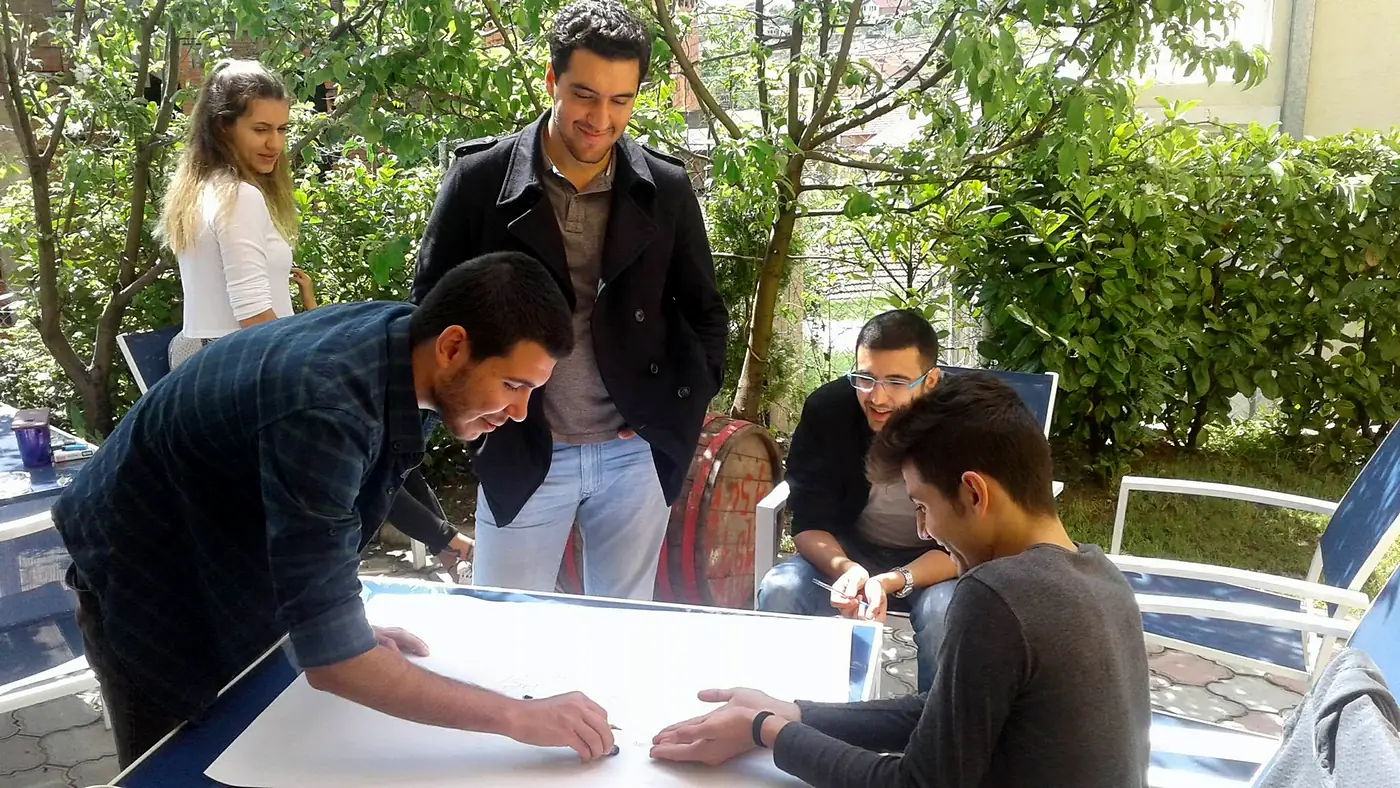
Young people with disabilities, every day
The day-care centre for people with disabilities in Stip (Novo Selo) has been open since 2006, with around ten daily beneficiaries, and the one in Delcevo since 2004, with around twenty. Not an outreach list — a service our own members work in.
Roma youth, through work already running
Roma youth integration through non-formal education, literacy work and music is part of what we do, not a target group we would go looking for once a grant is signed.
A Green Flag eco-school
Members of our organisation teach at primary school "Rade Kratovce" in Kocani, a Green Flag eco-school running a year-round eco calendar — a live classroom route for environmental and science results, not a cold approach to a headteacher.
Five towns, not one address
Branch offices in Kocani, Stip, Delcevo, Strumica and Lozovo. Rural and small-town communities across eastern North Macedonia, far from any capital — the geography that makes an engagement claim credible instead of decorative.
Professionals, not communications freelancers
Special-education and rehabilitation teachers, psychologists, pedagogues, social workers, nurses and a speech therapist. When your results need to reach people with intellectual disabilities, the plain-language work is done by people trained to do it.
A route into inclusive sport
We were the first organisation in North Macedonia to introduce the Paralympic sport Boccia, and we have two trained Boccia trainers. For health, inclusion and active-living topics, that is an engagement channel with a real community attached.
Our core target group is young people aged 17–30, with a strong focus on fewer opportunities — disability, economic obstacles, social obstacles and educational difficulties — plus Roma youth and schoolchildren. If your call's target population sits outside that, say so early and we will tell you honestly whether we can reach it.
What we can and cannot offer as a place
Community sites, described as exactly what they are
Some dissemination partners advertise a laboratory. We will not, because we do not have one. What we do have are working community premises where people are already present — usable for engagement activity, co-creation sessions, workshops, focus groups and multiplier events, and useless for anything requiring research infrastructure. Both halves of that sentence matter when you are writing a work package you will have to deliver.
Day-care centre, Delcevo
Operating since 2004 with around twenty daily beneficiaries. Occupational therapy rooms, an adapted sports hall, an adapted computer room and an adapted transport van. Staffed by five full-time and one part-time professionals, with ten to fifteen active volunteers.
Day-care centre, Stip (Novo Selo)
Operating since 2006 with around ten daily beneficiaries. Staffed by a psychologist, a special-education teacher, two nurses and a social worker. A setting for accessible-format testing and for engagement with people with intellectual disabilities and their families.
Eco-school, Kocani
Primary school "Rade Kratovce", a Green Flag eco-school with a year-round eco calendar, where members of our organisation teach. A route for classroom activities, pupil co-creation and science-education uptake.
Branch offices in five towns
Kocani, Stip, Delcevo, Strumica and Lozovo. Meeting space and a local presence for workshops, recruitment of participants and multiplier events across eastern North Macedonia.
Sports clubs and inclusive sport
Our inclusive-sport work, including Boccia with two trained trainers, gives access to clubs, athletes and families — useful for health, wellbeing and social-inclusion topics.
In-house media experience
We have run an online radio and a bilingual English/Macedonian youth magazine, and we take part in charity drives with the Red Cross. Production capacity that belongs to us rather than to a subcontractor.
To be clear, because people here know these buildings: the day-care centres in Delcevo (open since 2004) and Stip (open since 2006) are not ours. They long predate EVEC, which was founded in 2014, and they have their own teams and their own staff. We work with them and inside them, through our members who are employed there, and we do not claim their work or their people as our own.
Stated plainly: none of the above is a laboratory, a research infrastructure, a pilot facility or a demonstration site, and none of it should be written into a proposal as one. They are community premises and community relationships. Their value is access to people, not access to equipment.
Three ways to use us
Slot EVEC Kocani into your consortium as…
Option A
A contributing Horizon Europe partner on the impact work package
We take defined tasks inside your communication, dissemination and exploitation work package, under a work-package leader who has Horizon delivery behind them. Country-level communication, practitioner dissemination, accessible formats, national uptake. Clear tasks, clear deliverables, no ambiguity about who leads.
Option B
Citizen and youth engagement in a Widening country
Co-creation sessions, focus groups, participant recruitment and two-way engagement with young people with disabilities, Roma youth, schoolchildren and small-town communities. This is the task where our access is the reason to add us rather than a nice extra.
Option C
Multiplier events and national-level uptake
Events, training sessions and practitioner workshops in eastern North Macedonia, plus a third party or subcontracted role where your consortium is already full but still needs country coverage. Small, defined, deliverable.
A note on the fourth option that does not exist: we do not bid to coordinate, and we do not lead research work packages. If a proposal needs either, we are the wrong organisation and we would rather tell you in the first email than in month nine.
Where we fit
Honest fit, cluster by cluster
Fit here means fit for the engagement and dissemination tasks, never for the research. We have graded ourselves the way we would want a Horizon Europe partner to grade themselves for us.
Strongest fit
Inclusive society, youth, disability and social inclusion
Our core identity. Young people with fewer opportunities, disability services, Roma inclusion, democratic participation and non-formal education. Here our access is the substance of the engagement task, not a proxy for it.
Strong fit
Education, skills and science education
A Green Flag eco-school with teaching members of our organisation, plus eleven years of non-formal education delivery. Good ground for science-education uptake, classroom co-creation and teacher-facing dissemination.
Good fit · supporting role only
Green transition, food, energy and health promotion
Topics our eco-school and youth work can genuinely carry into communities. We contribute engagement and dissemination only — the science, the pilots and the measurement belong to partners equipped for them.
Our organisation is developing four educational methodologies — microgreens, mycelium, drones and solar — authored by our president Blagoj Ristov and piloted by our sister organisation EVEC Athens in Greece. In North Macedonia these are plans we are introducing, not results we have delivered, and they should be described that way in any proposal text. You can read what each one is at microgreens, mycelium, drones and solar.
Everything standard in an impact work package
The deliverables list, and where we sit on each one
This is the standard content of a Horizon communication, dissemination and exploitation work package. We can produce all of it. On a first Horizon project we would expect to produce most of it with a work-package leader rather than instead of one — and we would rather be the partner who says that than the one who discovers it at the first review.
We contribute to this work package — we do not bid to lead it on a first projectWhere we lead vs where we complement
Two columns, and we are honest about which one is longer
What we lead
Engagement and dissemination on the ground in North Macedonia
Within a work package someone else leads, these are tasks we take ownership of and answer for: recruitment of participants and co-creation sessions with young people who have fewer opportunities; accessible and plain-language versions of your outputs; practitioner dissemination to special-education staff, teachers, youth workers and municipal services; Macedonian-language communication; multiplier events across five towns; the non-commercial uptake route for results into schools, youth work and day-care practice.
What we complement
Everything that needs Horizon experience, research capacity or a lab
We contribute under someone else and do not pretend otherwise: work-package leadership on a first Horizon project; the overall plan for dissemination and exploitation as a formal deliverable; consortium-level reporting in the Funding & Tenders Portal; open-science and data-management strategy; any scientific content, measurement, pilot or validation activity; media relations beyond North Macedonia; and coordination of any kind.
Indicators
What we would count — and why there are no numbers on this page
You will find no reach figures, audience sizes or follower counts here, because we have never run a Horizon communication campaign and any number we printed would be invented. What we can tell you is exactly what we would track and how the target for each would be fixed: agreed with you at proposal stage, calibrated to your call, your budget and your audiences, and written into the plan for dissemination and exploitation, which is binding.
| Output | What we would report | How the target is fixed |
|---|---|---|
| Project website | Sessions and content publishedprivacy-compliant analytics only | Agreed with the coordinator at proposal stage |
| Social channels | Posts published and engagement, English and Macedonian | Agreed with the coordinator; we commit to activity, never to follower counts |
| Newsletters | Issues produced and distributed | Set against your project duration and reporting periods |
| Videos and short-form content | Items produced and published | Set against the budget line you allocate |
| Practitioner materials | Policy briefs, practice abstracts and factsheets | Set against the number of results with a practitioner audience |
| Accessible formats | Outputs produced in plain language and accessible versions | One per public-facing result, unless you specify otherwise |
| Multiplier events | Events held, towns covered, participants attending | Agreed with the coordinator; participants counted, never estimated |
| Engagement sessions | Co-creation and focus-group sessions, and who took part | Set against the engagement design you need for the Impact section |
| Key exploitable results | Results described and uptake routes documented | Follows your results list, not a target we invent |
| Horizon Results Platform | Entries uploaded and maintained | One per eligible result |
Every figure in the right-hand column is a commitment to be agreed with you, not a result we have achieved. If a partner shows you a table of impressive dissemination numbers with no project attached to them, ask which grant agreement they came from.
Compliance, reliability and reporting
We run EU projects to the letter — that part is not new to us
On every communication and dissemination output, with the emblem sized correctly against other logos and the standard disclaimer attached. We have applied this discipline on EU-funded projects since 2015.
Practical support for depositing publications in trusted repositories and applying open licences, working alongside the partners who own the scientific content. We support this work; we do not set the open-science strategy.
We log activity as it happens and report on time. On a first Horizon project we would ask the coordinator to walk us through the Funding & Tenders Portal continuous reporting module before the first period, rather than improvise it.
Written consent for photographs, testimonials and mailing lists, and safeguarding procedures that matter more than usual when participants include young people with disabilities and children. Our approach is published at safeguarding and privacy.
Nothing goes to media or to a public channel without the coordinator's clearance. We reply to consortium correspondence within three working days, and we would rather ask a question early than deliver the wrong thing on time.
Our track record
Eleven years of EU delivery. Zero Horizon projects. Both numbers are on this page.
Everything below is a reference code you can look up yourself. We would rather you checked than took our word for it — that is the whole point of publishing them.
The one we coordinated
Entrepreneurial Development Through Internet and Social Media
Erasmus+ VET mobility, coordinated by EVEC Kocani from application through to final report with the Macedonian National Agency. Grant of EUR 58,896, running 2020 to 2022. It is the only budget figure published anywhere on this page, and it is the real one.
2020-1-MK01-KA102-077700Running right now
Green Pathways: Empowering NEET Youth for a Sustainable Future
Our Stip branch is a partner in this Erasmus+ youth project, September 2025 to October 2026, with a Romanian coordinator and partners in Romania, North Macedonia, Poland, Greece, Turkey and Bulgaria. Proof that we are currently delivering inside a multi-country consortium, on someone else's coordination.
2025-1-RO01-KA153-YOU-000298169Partner references you can verify
2016-1-TR01-KA105-030607
2017-1-TR01-KA105-037391
2017-1-SI02-KA105-014050
2017-2-TR01-KA105-047053
2018-2-TR01-KA125-060455
2018-1-SI02-KA125-014508
2019-3-TR01-KA347-079958
2020-3-EL02-KA105-006615Every code above is searchable on the Erasmus+ Project Results platform. Our European Solidarity Corps Quality Label for Hosting and Supporting, valid to 31 December 2027, is listed on the European Youth Portal. We hold no Erasmus+ accreditation, and we say so in the same breath. More detail sits on our projects and about pages.
How we work with coordinators
From your call to a ready Horizon Europe partner — without wasting your deadline
Send us the call
The topic identifier, the type of action and your submission deadline. Two lines is enough to start.
We answer within three working days
Either a straight no with the reason, or an outline of the engagement and dissemination tasks we would take, the audiences we would reach and how we would report them. A letter of intent on request.
Part B text you can paste
Organisation description, role and capability, our identifiers, and the honest paragraph about being new to Horizon — written so it strengthens the proposal rather than hiding in it.
On award, we deliver and we ask
Tasks delivered to the letter, emblem and funding statement on everything, activity logged as it happens — and questions asked early about anything Horizon-specific we have not done before.
If the answer is no, you get it in the first reply. We would rather lose a place in a consortium than be the partner a coordinator has to manage around.
Add EVEC Kocani to your proposal
Send the topic identifier and the deadline. You get back a defined set of engagement and dissemination tasks, the audiences behind them, and a plain statement of what we have not done before.
One page, everything a coordinator needs to enter us in the participant portal.
Deadline in the next few weeks? Write anyway — we answer within three working days.
One-page partner profile
943554018E10119353Save yourself the email
Who this is NOT for
Every organisation should publish this list. Here is ours, and none of it is false modesty — each line is a real reason to choose a different Horizon Europe partner.
- Consortia that need a research partner. We are a citizens' association, not a research organisation and not a university. We do not carry scientific work packages, we do not run experiments, and we should never appear in a proposal as a research beneficiary.
- Consortia that need a coordinator. We do not coordinate Horizon Europe projects. Not on this call, not on the next one.
- Calls whose partner requirements include demonstrated Horizon Europe delivery. We do not meet that requirement. Checking it before you write to us saves us both a week.
- Anyone who needs a laboratory, a pilot facility, a demonstration site or research infrastructure. We have community premises. That is a genuinely different thing and we will not blur the two.
- Coordinators shopping for reach figures. If you need a partner who will state an audience number in the proposal so the Impact section looks solid, we are the wrong choice. We commit to activity and count what actually happens.
- Anyone looking for a communications agency. We are practitioners — teachers, psychologists, social workers — who do communication because our projects need it. If you want an agency, hire an agency; they are faster and they have a rate card.
- Proposals that need a partner in a specific EU Member State. North Macedonia is an associated country, not a Member State. If your call or your consortium balance requires a Member State entity in this slot, we cannot be it.
- Anyone who wants a PIC to fill a gap the day before the deadline. We will not join a consortium whose work package we have not read. If we take a task, we intend to deliver it.
If you have read this far and none of the above rules you out, the fit is probably real. The form at the bottom of this page is the fastest route.
Questions coordinators actually ask
Frequently asked questions
Can an organisation in North Macedonia be a full beneficiary in Horizon Europe?
Yes. North Macedonia has been fully associated to Horizon Europe since January 2021, which means entities established here participate as full beneficiaries under the same conditions as entities from EU Member States. That is the factual basis of this whole page, and it is the one part of our position that requires no argument from us. Beyond that plain statement we make no claims about special status — check the conditions of your specific call, as you would for any partner.
You really have never been in a Horizon Europe project?
Correct. No beneficiary role, no third-party role, no associated partner role, no subcontract. Our EU delivery record is entirely in Erasmus+ and the European Solidarity Corps — seventeen projects across the network since 2015, one of which we coordinated ourselves. We put that fact in the hero of this page rather than the footnotes because a coordinator will find it out anyway, and finding it out late is worse for everyone.
What does adding a Horizon newcomer actually cost us as coordinator?
Honestly: some of your time in the first reporting period. You would need to point us at the right module in the Funding & Tenders Portal, confirm the deliverable format you want, and check our first submission. After that the pattern is the same discipline we already apply to EU grants — deadlines, evidence, emblem, consent, activity logs. What you get in exchange is a Horizon Europe partner with access you cannot buy from an agency, in a country where your results are not already saturated, at civil-society cost levels.
Which work package would you sit in?
The communication, dissemination and exploitation work package, plus whichever engagement or citizen-participation task sits alongside it. We take defined tasks inside that work package under a leader with Horizon experience. We do not sit in scientific work packages, and we do not ask to lead the impact work package on a first Horizon project — if that changes on a second one, that is a conversation for then.
What exactly do you mean by access to hard-to-reach groups?
Something narrower and more literal than the phrase usually means. The day-care centre for people with disabilities in Stip has been open since 2006, with around ten daily beneficiaries, and the one in Delcevo since 2004, with around twenty; our members work inside both. Neither centre is ours — both long predate EVEC and we cooperate with them. Members of our organisation teach at a Green Flag eco-school in Kocani. We run Roma youth integration work through non-formal education, literacy and music. We have branch offices in five towns in eastern North Macedonia. These are relationships that already exist, staffed by professionals already employed in those settings — not audiences we would go and find after your grant is signed.
Why are there no KPI numbers anywhere on this page?
Because we have never run a Horizon communication campaign, so any figure we printed would be a guess dressed up as evidence. What we publish instead is the list of what we would track and the statement that every target is agreed with the coordinator at proposal stage and written into the binding plan for dissemination and exploitation. If you need indicative ranges for your Part B, we will build them with you against your call, your budget and your audiences — clearly labelled as targets, which is what they are.
Do you have a demonstration site, a pilot facility or research facilities?
No, and we would rather lose the partnership than claim otherwise. What we have are community premises: the two day-care centres for people with disabilities our members work in — the Delcevo one with occupational therapy rooms, an adapted sports hall, an adapted computer room and an adapted transport van — an eco-school, sports clubs and branch offices in five towns. They are excellent for engagement, workshops, co-creation and accessible-format testing. They are not laboratories and must not be written up as any kind of research infrastructure.
What are the microgreens, mycelium, drones and solar methodologies, and can we use them?
They are four educational methodologies authored by our president, Blagoj Ristov, and piloted by our sister organisation EVEC Athens in Greece — a legally separate organisation founded in 2017. In North Macedonia we are introducing them: they are plans here, not delivered results, and any proposal text must describe them that way. If a topic touches food, biomaterials, aerial technology or renewable energy, they are a genuine reason to talk to us about educational uptake — provided nobody writes them up as an evidence base we do not yet have. Read them at microgreens, mycelium, drones and solar.
Are you accredited under Erasmus+?
No. We hold a European Solidarity Corps Quality Label for Hosting and Supporting, valid to 31 December 2027 and listed publicly on the European Youth Portal. We do not hold an Erasmus+ accreditation, and we correct anyone who assumes we do. Neither of these is required for Horizon Europe participation — we list them because they show an organisation that has passed external quality assessment and stayed in good standing.
Who would we actually be working with day to day?
Professionals already employed in the day-care centres our network works with, documented in our accreditation forms: in Delcevo, five full-time and one part-time professionals — a special-education and rehabilitation teacher, a psychologist, a pedagogue, a social worker, a nurse and a part-time speech therapist — supported by ten to fifteen active volunteers; in Stip, a psychologist, a special-education teacher, two nurses and a social worker; in Kocani, university-educated teachers plus a pedagogue and a psychologist. The first point of contact is Blagoj Ristov, our president.
Can you take a subcontract or third-party role instead of a full Horizon Europe partner slot?
Yes, and sometimes that is the sensible answer. If your consortium is complete but you still need country coverage, multiplier events or engagement with specific groups in North Macedonia, a defined third-party or subcontracted role is easier for everyone than reopening the partner list. Tell us which structure your call allows and we will work inside it.
How quickly do you reply, and to whom?
Within three working days, to contact@evec.org.mk, read by the people who would actually do the work. That holds whether you are proposing a full partner slot or only asking whether the fit is real. Response time is a fair thing to test before you commit to any partner, so test ours — especially if your deadline is close.
What do you need from us to give a useful answer?
Three things: the topic identifier, the type of action, and your submission deadline. If you can add the target population and whether the impact work package already has a leader, our first reply goes straight to concrete tasks instead of clarifying questions. If we cannot help, that first reply says so.
Is EVEC Athens part of your organisation?
EVEC Athens is our sister organisation in Greece, founded in 2017, and it is a legally separate entity with its own identifiers. A consortium contracting with EVEC Kocani contracts with EVEC Kocani. We mention the relationship because the four educational methodologies were piloted there and because it is where our approach was first tested — not to borrow anyone else's track record.
Let's talk before your deadline
Tell us the call. We will tell you honestly whether we help.
Send the topic identifier, the type of action and the deadline. Within three working days you get either a clear no with the reason, or a set of engagement and dissemination tasks we would take, the audiences behind them and the honest paragraph about being new to Horizon Europe.
Reply within three working days — including a noPrefer to check us first? Our Quality Label is listed on the European Youth Portal and every project code on this page is searchable on the Erasmus+ Project Results platform.
Horizon Europe partnership enquiry
Straight to a person, not a form
Email us instead
Three lines is enough: the topic identifier, the type of action, and your deadline. We reply within three working days.
Email contact@evec.org.mkEVEC Kocani · PIC 943554018 · OID E10119353 · Ul. Boris Trajkovski 42, 2300 Kocani, North Macedonia · +389 78 275 770
Beyond dissemination
The rest of what we do
For organisations
Erasmus+ partnerships
Six programme strands — youth, VET, school education, adult education, sport and volunteering — where our delivery record actually sits.
Open the hub →The organisation
About EVEC Kocani
Who we are, where our branch offices are, what we hold and what we do not — with the same honesty as this page.
Meet us →The evidence
Our projects
Every EU project we have taken part in, with reference codes you can look up on the Commission's own platform.
Check the record →EVEC Kocani’s Erasmus+ and European Solidarity Corps projects are co-funded by the European Union. This page is not itself an output of an EU-funded project. Views and opinions expressed are those of the author(s) only and do not necessarily reflect those of the European Union or the European Education and Culture Executive Agency (EACEA). Neither the European Union nor EACEA can be held responsible for them.
EVEC Kocani · European Voluntary and Educational Center Kocani · PIC 943554018 · OID E10119353 · Kocani, North Macedonia · Contact: contact@evec.org.mk